Description
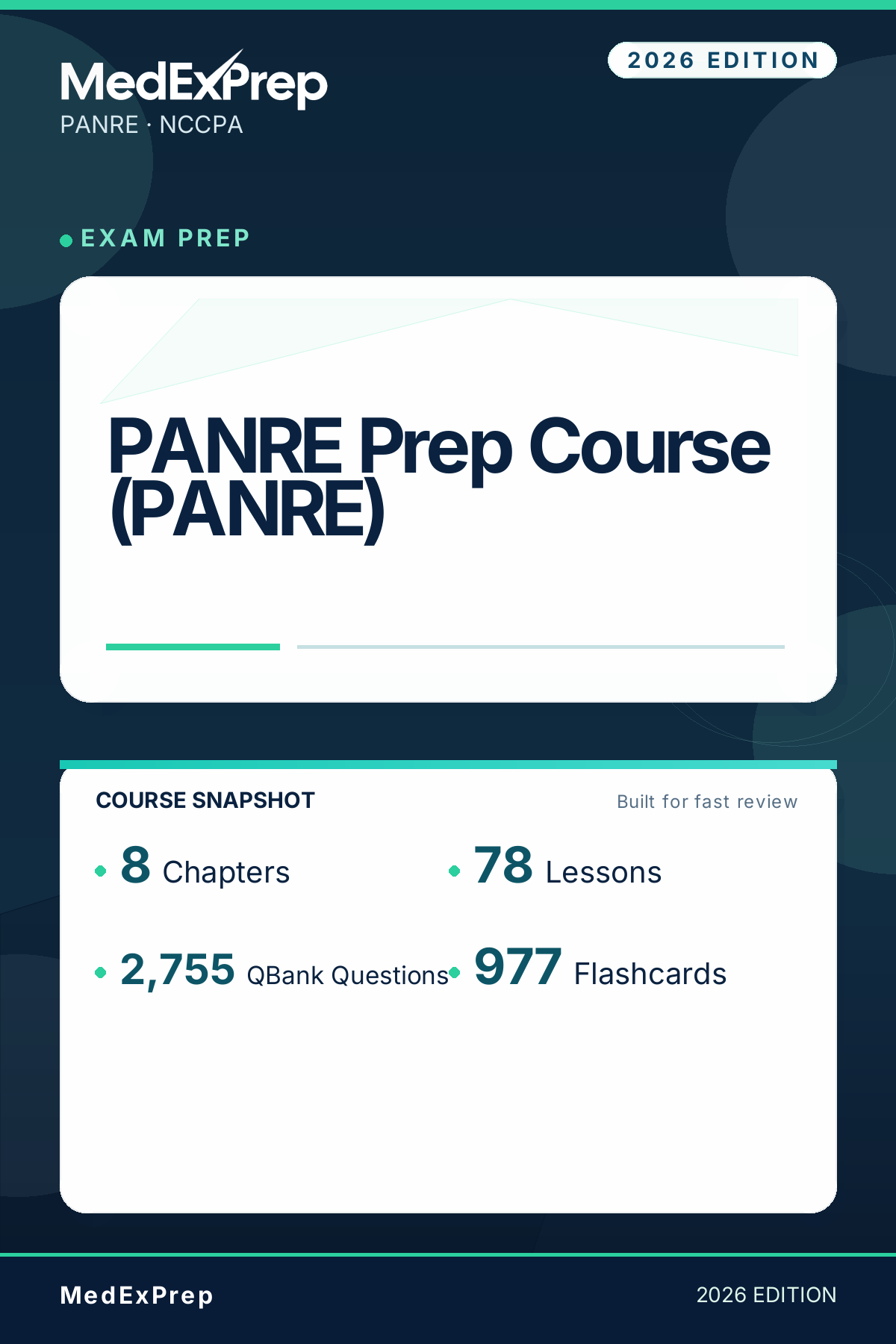
PANRE Prep Course (PANRE)
Certified Physician Assistants preparing for the PANRE recertification exam, including practicing PAs seeking a high-yield, exam-focused review of general medical knowledge and clinical decision-making. Key goals: By the end of this course, learners will be able to:; Explain the PANRE exam structure at a high level, the major clinical content areas commonly represented, and the main task types tested; if exact weighting is not confirmed in the provided inputs, use current publicly available NCCPA guidance and do not invent percentages..
Exam: PANRE · Organization: NCCPA
Includes: Lessons + Flashcards + QBank
Audience: Certified Physician Assistants preparing for the PANRE recertification exam, including practicing PAs seeking a high-yield, exam-focused review of general medical knowledge and clinical decision-making.
Goals:
- By the end of this course, learners will be able to:
- Explain the PANRE exam structure at a high level, the major clinical content areas commonly represented, and the main task types tested; if exact weighting is not confirmed in the provided inputs, use current publicly available NCCPA guidance and do not invent percentages.
- Master high-yield generalist clinical knowledge across major PANRE-relevant domains, including disease recognition, diagnostic criteria, diagnostic study selection, initial management, ongoing management principles, prevention, complications, contraindications, and referral/escalation thresholds.
- Apply clinical reasoning in realistic PANRE-style scenarios by using a consistent framework: identify the task → extract key findings → prioritize the differential → choose the best diagnostic or management step → verify against safety, contraindications, and follow-up needs.
- Interpret common exam-relevant data accurately, including labs, imaging descriptions, ECG patterns, medication effects/interactions, and risk features, using stepwise reasoning rather than unsupported shortcuts.
- Distinguish common look-alikes, distractors, misconceptions, boundary cases, red flags, and unsafe choices that frequently appear in general medical recertification questions.
- Build retrieval-ready memory with illness scripts, concise tables, algorithms, checklists, comparison charts, and spaced-review summaries that emphasize discriminating features and next-step decisions.
- Demonstrate readiness through self-checks, mini-assessments, and mixed review sets mapped to PANRE content areas, task categories, and explicit subskill tags.
- Coverage & Blueprint Mapping Requirements:
- Every chapter, section, subsection, and topic must map to at least one PANRE-relevant content area, at least one task category, and an explicit subskill tag.
- Use consistent subskill labels in the form: CLINICAL AREA: Topic → Subskill.
- Cover broad generalist clinical domains relevant to PANRE-style recertification, including cardiovascular, pulmonary, gastrointestinal/nutrition, musculoskeletal/rheumatology, infectious disease, endocrinology, neurology, nephrology/urology, dermatology, hematology/oncology, EENT, reproductive health, psychiatry/behavioral medicine, and preventive care/health maintenance.
- Within each major content area, ensure coverage of diagnosis, evaluation, and management; include prevention/follow-up, complications, patient safety, and referral/escalation when clinically relevant.
- When blueprint language or weighting is broad or evolving, translate it into teachable subskills and map all content explicitly; flag uncertainty through learner-safe wording rather than guessing.
- Stay within the candidate role of a recertifying PA-C using broad general medical reasoning; avoid highly subspecialized details unless needed for recognition, indications, contraindications, complications, or exam-relevant next-step decisions.
- If recommendations vary by guideline version, practice setting, or institution, state that management may vary and learners should confirm current recommendations rather than presenting uncertain details as universal rules.
Access is granted immediately after purchase.