Description
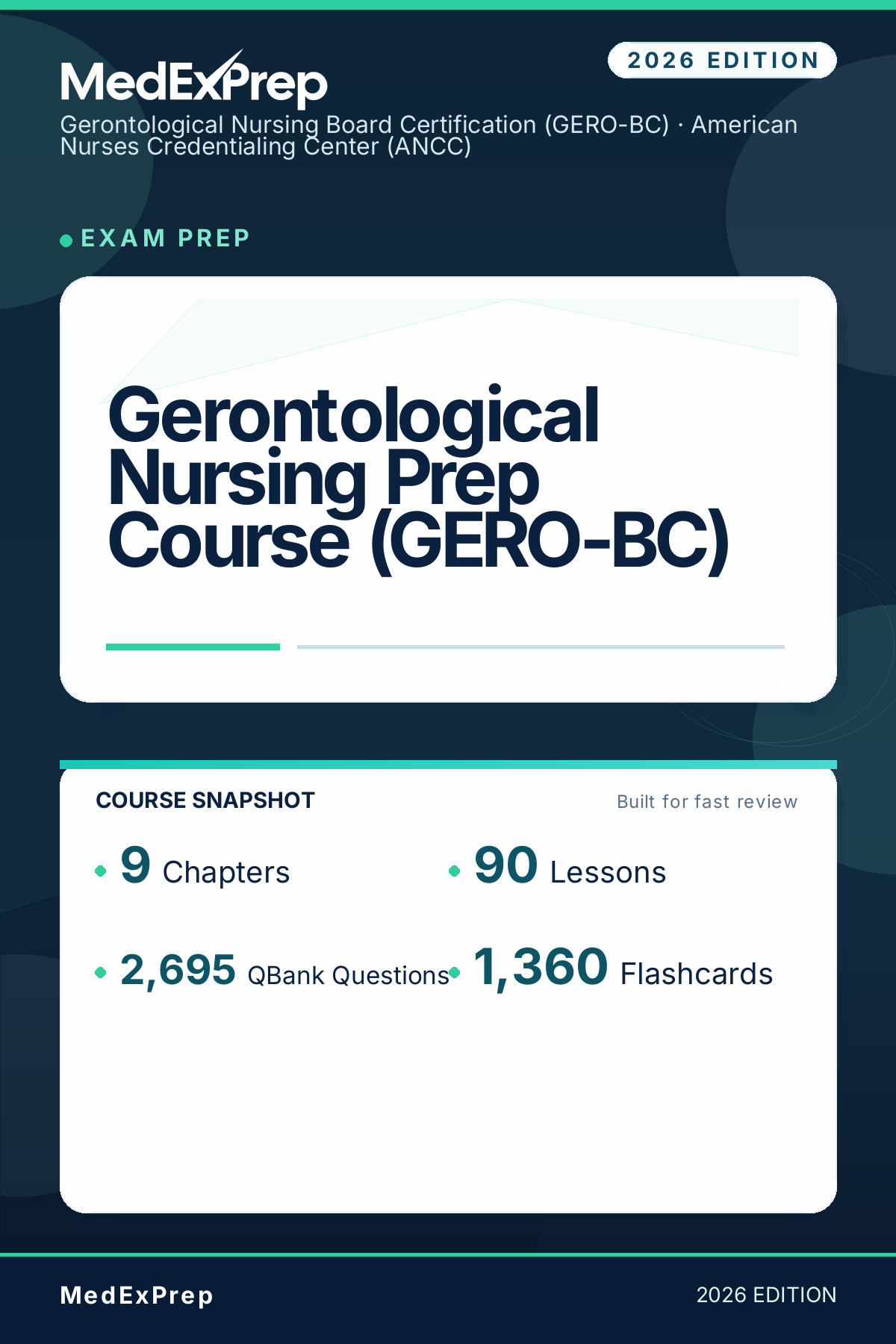
Gerontological Nursing Prep Course (GERO-BC)
Registered nurses preparing for the ANCC Gerontological Nursing Board Certification (GERO-BC) exam, including practicing nurses transitioning into gerontological nursing, experienced adult/medical-surgical nurses seeking specialty certification, and candidates needing exam-focused review of older-adult assessment, geriatric syndromes, chronic disease and multimorbidity management, polypharmacy, safety, ethics, care coordination, transitions of care, and healthy aging across settings. Key goals: By the end of this course, learners will be able to:; Explain the exam blueprint or competency areas for gerontological nursing certification and how each lesson maps to those areas, even when blueprint language is broad..
Exam: Gerontological Nursing Board Certification (GERO-BC) · Organization: American Nurses Credentialing Center (ANCC)
Includes: Lessons + Flashcards + QBank
Audience: Registered nurses preparing for the ANCC Gerontological Nursing Board Certification (GERO-BC) exam, including practicing nurses transitioning into gerontological nursing, experienced adult/medical-surgical nurses seeking specialty certification, and candidates needing exam-focused review of older-adult assessment, geriatric syndromes, chronic disease and multimorbidity management, polypharmacy, safety, ethics, care coordination, transitions of care, and healthy aging across settings.
Goals:
- By the end of this course, learners will be able to:
- Explain the exam blueprint or competency areas for gerontological nursing certification and how each lesson maps to those areas, even when blueprint language is broad.
- Master high-yield gerontological nursing concepts for older adults across the continuum of care, including normal aging versus abnormal findings, comprehensive geriatric assessment, geriatric syndromes, chronic illness and multimorbidity, medication safety, function, cognition, psychosocial needs, caregiver support, palliative principles, and health promotion.
- Apply gerontological nursing knowledge in realistic exam-style scenarios from the RN perspective: identify priorities, recognize urgent changes, choose the most appropriate nursing action, monitor response, and coordinate escalation or referral when indicated.
- Use a consistent clinical reasoning framework for board-style questions: identify the task → extract key age-related and situational clues → distinguish expected aging from pathology → select the governing nursing principle, safety rule, or priority framework → act within RN scope → verify the choice against patient goals and risk.
- Distinguish common distractors in older-adult questions, including ageist assumptions, attributing acute changes to dementia or “just aging,” unsafe polypharmacy choices, convenience-based restraint logic, discharge plans that ignore function/support, and options that exceed RN scope.
- Strengthen exam readiness with retrieval-focused study tools, concise tables, decision frameworks, care-priority checklists, and self-checks mapped to each competency area.
- Coverage & Blueprint Mapping Requirements:
- Every chapter, section, subsection, and topic must map to at least one exam domain, competency area, or teachable subskill relevant to gerontological nursing certification.
- If the published blueprint is limited or broad, translate it into explicit subskills using a consistent tag format such as DOMAIN: Objective → Subskill.
- Ensure balanced coverage of core gerontological nursing themes likely to be tested: assessment; safety and risk reduction; cognition and mental health; mobility and function; skin, continence, nutrition, sleep, and pain; medication monitoring and polypharmacy; ethics, autonomy, elder justice, and advance care planning; care transitions, interdisciplinary coordination, and community resources; chronic illness management; supportive and end-of-life care; and healthy aging.
- Preserve the RN lens at all times: assessment, prioritization, implementation, evaluation, teaching, documentation, advocacy, and collaboration. Do not drift into provider-only diagnosis, prescribing, or legal determinations.
- Ensure complete coverage: no domain/objective is left unmapped; if a specific detail is uncertain or institution-dependent, provide learner-safe guidance such as “Local protocols vary; confirm with your institution” rather than guessing.
- When multiple settings are relevant, frame care decisions across acute care, ambulatory care, home health, long-term care, rehabilitation, hospice, and community contexts so learners can generalize exam reasoning.
Access is granted immediately after purchase.