Description
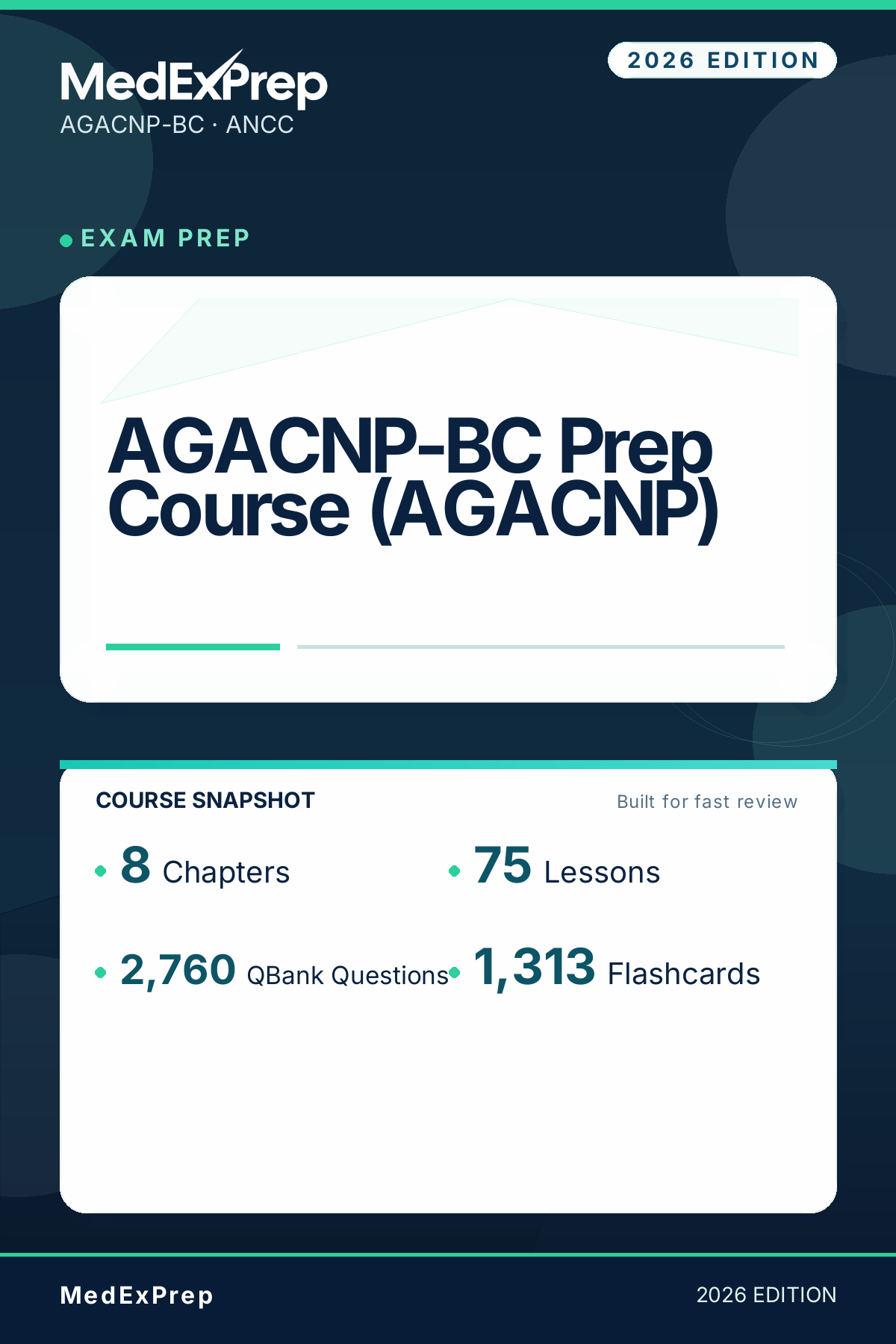
AGACNP-BC Prep Course (AGACNP)
Adult-Gerontology Acute Care Nurse Practitioner candidates preparing for the ANCC AGACNP-BC certification exam, including NP students nearing graduation and practicing NPs seeking initial board certification in adult-gerontology acute care. Key goals: By the end of this course, learners will be able to:; Explain the ANCC AGACNP-BC exam focus areas at a high level and use a domain-based study plan without relying on unpublished blueprint details..
Exam: AGACNP-BC · Organization: ANCC
Includes: Lessons + Flashcards + QBank
Audience: Adult-Gerontology Acute Care Nurse Practitioner candidates preparing for the ANCC AGACNP-BC certification exam, including NP students nearing graduation and practicing NPs seeking initial board certification in adult-gerontology acute care.
Goals:
- By the end of this course, learners will be able to:
- Explain the ANCC AGACNP-BC exam focus areas at a high level and use a domain-based study plan without relying on unpublished blueprint details.
- Master the high-yield concepts, definitions, acute care decision rules, and professional role expectations relevant to adult-gerontology acute care board preparation.
- Apply concepts in realistic board-style scenarios involving adult and older adult acute/critical illness, including prioritization, safest next step, differential diagnosis, and reassessment.
- Interpret common acute care data within exam scope, including trends in vital signs, laboratory results, ECG-related reasoning, imaging summaries, hemodynamic/monitoring cues, and response-to-treatment patterns.
- Select evidence-aligned pharmacologic and nonpharmacologic management strategies for common acute and critical care presentations, with attention to contraindications, escalation, and care setting.
- Distinguish common distractors, unsafe actions, scope violations, and look-alike diagnoses frequently tested in board-style questions.
- Use a consistent clinical reasoning framework: identify the task → assess stability/acuity → extract key findings → prioritize likely diagnoses/problems → choose the safest next step → verify against contraindications, care setting, and AGACNP role scope.
- Build retrieval-ready memory using concise tables, illness scripts, checklists, escalation algorithms, and spaced review summaries.
- Demonstrate readiness through self-check questions and mini-assessments mapped to learner-facing subskills across these instructional domains: Assessment and Clinical Reasoning; Diagnostics and Monitoring; Management of Acute and Critical Conditions; Professional Role, Safety, and Systems-Based Practice.
- Coverage & Blueprint Mapping Requirements:
- Every chapter/section/subsection/topic must map to at least one learner-facing domain/subskill tag, using the format DOMAIN: Objective -> Subskill.
- Use high-level ANCC AGACNP-BC framework categories where publicly stated, but do not invent unpublished official blueprint weightings or unsupported subdomains.
- When blueprint language is broad, translate it into teachable subskills such as: Assessment and Clinical Reasoning: Severity recognition -> Identify shock, respiratory failure, sepsis, altered mental status, and other time-sensitive syndromes.
- Ensure complete coverage across adult-gerontology acute care exam scope, including advanced assessment, pathophysiology integration, differential diagnosis, diagnostics, pharmacologic management, nonpharmacologic management, acute care syndromes, critical care syndromes, monitoring/procedural awareness within role expectations, transitions of care, ethics, safety, and professional role responsibilities.
- Keep all content within adult and older adult acute care NP scope; exclude pediatric/neonatal care and avoid specialty minutiae beyond exam-relevant recognition/management awareness.
- If a detail is uncertain or institution-dependent, write learner-safe guidance such as: local protocols vary; confirm with your institution.
Access is granted immediately after purchase.