Description
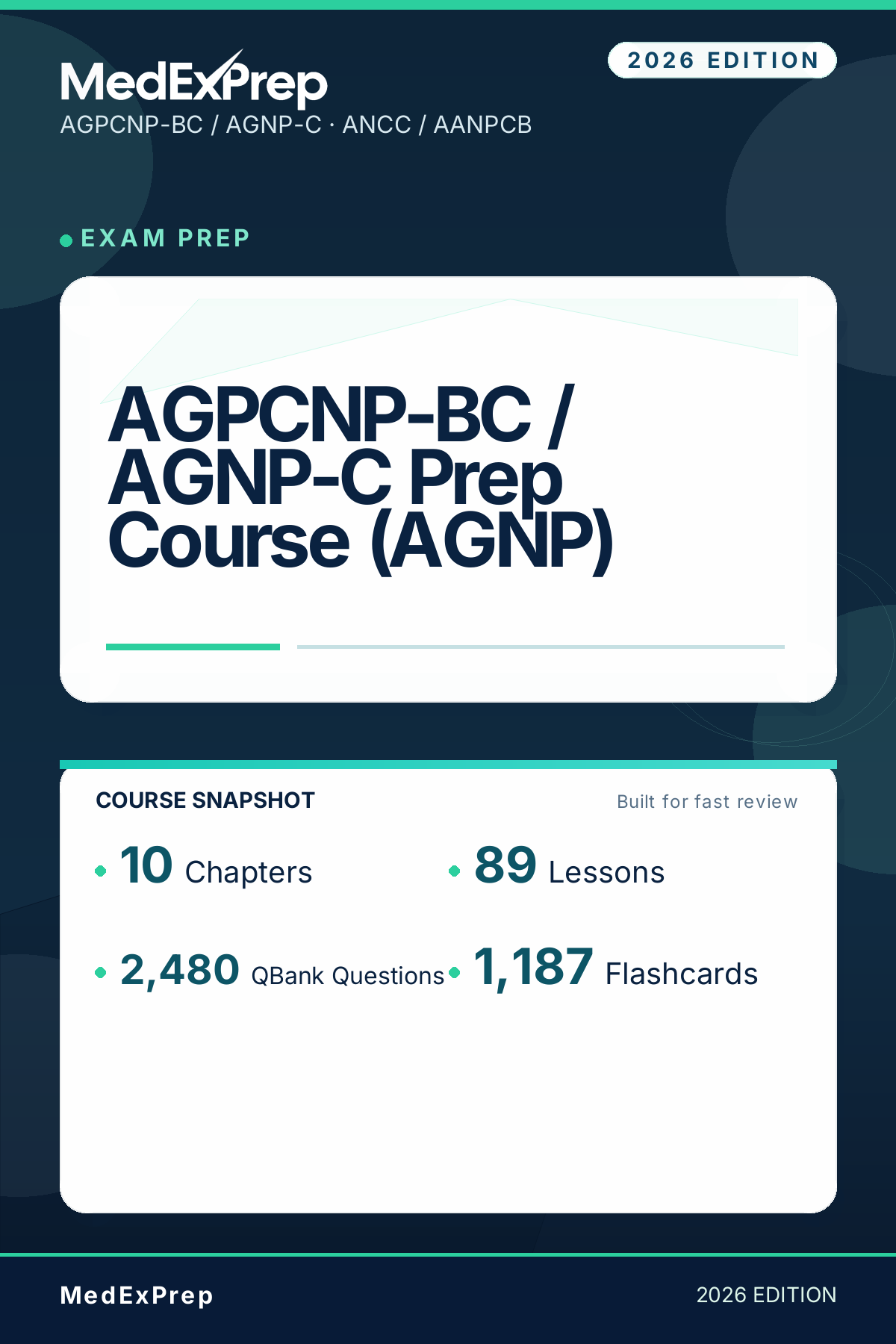
AGPCNP-BC / AGNP-C Prep Course (AGNP)
Adult-Gerontology Primary Care Nurse Practitioner certification candidates preparing for the ANCC AGPCNP-BC and/or AANPCB AGNP-C exams Key goals: By the end of this course, learners will be able to:; Explain the current ANCC AGPCNP-BC and/or AANPCB AGNP-C exam framework at a high level and understand how each lesson maps to tested adult-gerontology primary care competencies without inventing unsupported blueprint details..
Exam: AGPCNP-BC / AGNP-C · Organization: ANCC / AANPCB
Includes: Lessons + Flashcards + QBank
Audience: Adult-Gerontology Primary Care Nurse Practitioner certification candidates preparing for the ANCC AGPCNP-BC and/or AANPCB AGNP-C exams
Goals:
- By the end of this course, learners will be able to:
- Explain the current ANCC AGPCNP-BC and/or AANPCB AGNP-C exam framework at a high level and understand how each lesson maps to tested adult-gerontology primary care competencies without inventing unsupported blueprint details.
- Master the high-yield concepts, definitions, clinical rules, and prescribing principles relevant to adult-gerontology primary care across prevention, assessment, diagnosis, management, and older-adult care.
- Apply concepts in realistic outpatient primary care, exam-style scenarios involving adolescents transitioning to adulthood, adults, and older adults within NP primary care scope.
- Use a consistent clinical reasoning framework: identify the task -> extract key history/exam findings -> determine age/risk/context -> select the governing guideline or principle -> choose the best next step -> verify safety, follow-up, and referral needs.
- Distinguish common distractors, look-alike conditions, contraindications, red flags, age-related nuances, and tempting but premature testing or treatment choices frequently seen on board-style questions.
- Solve calculation, interpretation, and logic tasks accurately when applicable, showing steps and avoiding shortcuts that hide reasoning.
- Build retrieval-ready memory using concise tables, checklists, algorithms, comparative drug/class summaries, and spaced rapid-review points.
- Demonstrate readiness through self-checks and mini-assessments mapped to shared adult-gerontology primary care crosswalk tags and, when possible, to current ANCC and/or AANPCB framework language.
- Coverage & Blueprint Mapping Requirements:
- Every chapter, section, subsection, and topic must map to at least one current ANCC and/or AANPCB domain/objective or to a defensible shared crosswalk tag when board wording is broad.
- Use a consistent mapping format: DOMAIN: Objective -> Subskill.
- Build a shared adult-gerontology primary care curriculum first, then crosswalk each lesson to the closest available ANCC and/or AANPCB framework language.
- Ensure complete coverage across prevention/screening, health assessment, diagnostic reasoning, episodic care, chronic disease management, pharmacology/prescribing principles, older-adult syndromes, and professional role/ethics/quality-safety content only where supported by the exam framework.
- Do not invent official percentages, named subdomains, or unsupported board claims. If a framework detail is uncertain or varies by board, guideline, institution, formulary, or jurisdiction, provide learner-safe wording such as: current blueprint language should be confirmed at course build time, local protocols vary, and prescribing authority/jurisdictional rules should be confirmed with the learner's state or institution.
- Clearly distinguish routine outpatient management from urgent evaluation, emergency referral, or specialty consultation thresholds.
- Keep all content within entry-to-practice Adult-Gerontology Primary Care NP scope; include specialty topics only as recognition, initial workup, referral, or co-management thresholds when relevant to the exam.
Access is granted immediately after purchase.