Description
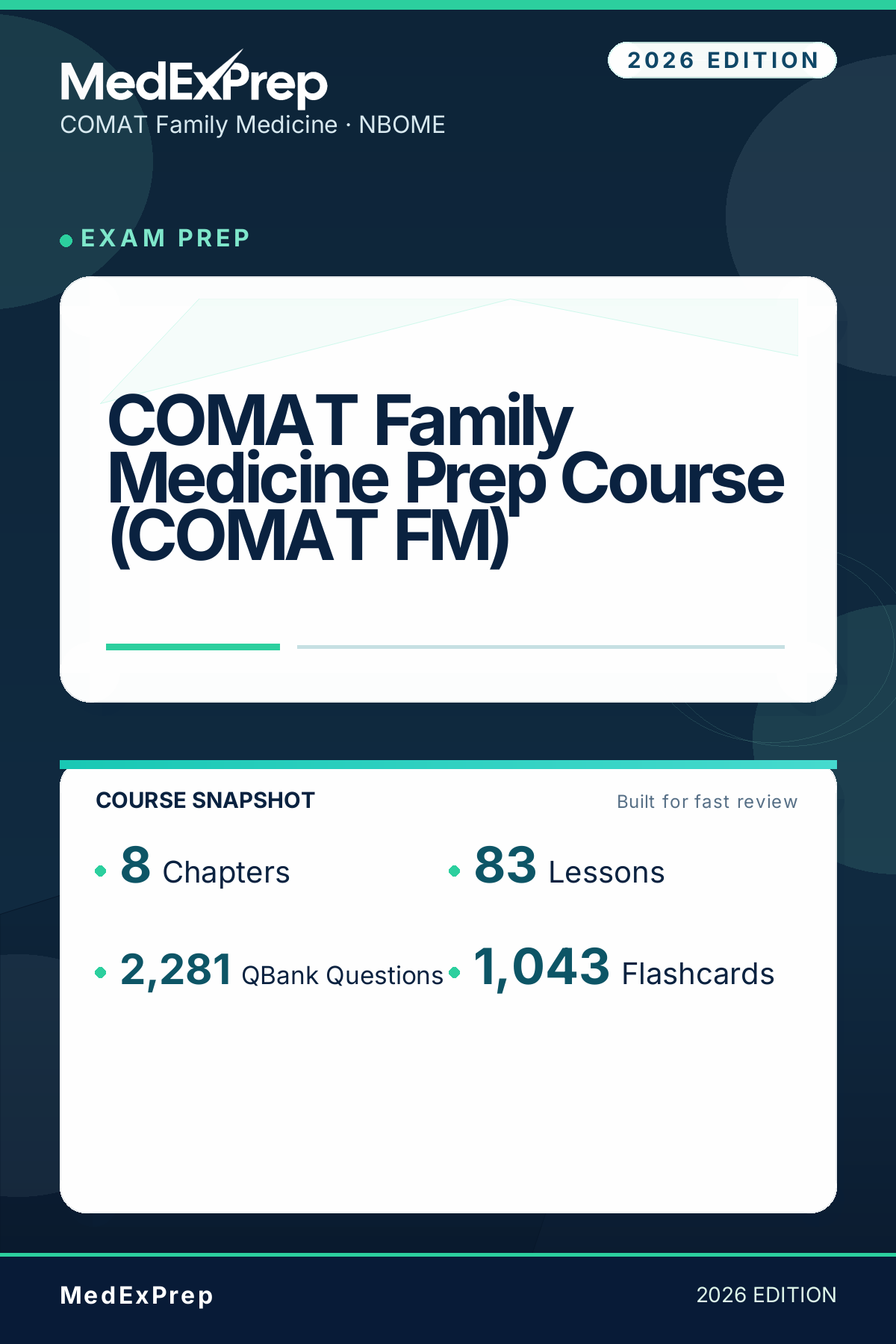
COMAT Family Medicine Prep Course (COMAT FM)
Medical students preparing for the NBOME COMAT Family Medicine subject examination, especially osteopathic medical students in core or elective family medicine clerkships. Target the clerkship-level examinee functioning in ambulatory family medicine, continuity clinic, preventive care, urgent office visits, and longitudinal primary care follow-up. Key goals: By the end of this course, learners will be able to:; Explain the course’s learner-safe domain map for COMAT Family Medicine and use it to organize study across ambulatory family medicine topics without assuming unofficial NBOME weighting..
Exam: COMAT Family Medicine · Organization: NBOME
Includes: Lessons + Flashcards + QBank
Audience: Medical students preparing for the NBOME COMAT Family Medicine subject examination, especially osteopathic medical students in core or elective family medicine clerkships. Target the clerkship-level examinee functioning in ambulatory family medicine, continuity clinic, preventive care, urgent office visits, and longitudinal primary care follow-up.
Goals:
- By the end of this course, learners will be able to:
- Explain the course’s learner-safe domain map for COMAT Family Medicine and use it to organize study across ambulatory family medicine topics without assuming unofficial NBOME weighting.
- Recognize and differentiate high-yield outpatient family medicine presentations across the lifespan, including pediatrics, adolescents, adults, women’s health, men’s health, geriatrics, behavioral health, dermatology, and musculoskeletal complaints.
- Apply family-medicine-style clinical reasoning in exam vignettes: identify the task → extract key facts → determine the likely diagnosis or care priority → select the best next step → verify against distractors, contraindications, and unsafe alternatives.
- Choose appropriate screening, prevention, immunization, counseling, follow-up, referral, and disposition decisions commonly tested in ambulatory primary care.
- Perform initial evaluation and first-line outpatient management for common acute complaints and chronic diseases at the clerkship level, while recognizing red flags that require urgent escalation, emergency referral, or specialist involvement.
- Interpret common primary care data accurately, including routine labs, screening results, chronic disease metrics, and simple clinical calculations when applicable, showing steps clearly.
- Distinguish common distractors in COMAT-style questions, including premature testing, incorrect screening choices, inappropriate antibiotics, overaggressive subspecialty management, and unsafe disposition.
- Build retrieval-ready memory using concise tables, checklists, age-based comparisons, decision pathways, and spaced review summaries mapped to domain tags.
- Demonstrate readiness with self-checks and mini-assessments mapped to explicit tags in the format 'FM Domain: Topic → Subskill.'
- Coverage and blueprint mapping requirements:
- Every chapter, section, subsection, and topic must map to at least one explicit tag in the format 'FM Domain: Topic → Subskill.' Cross-cutting topics may use multiple tags.
- Use a broad, learner-safe domain map rather than claiming official NBOME blueprint weighting unless such weighting is explicitly provided.
- Ensure complete coverage across preventive care and health maintenance; pediatrics; adolescent medicine; women’s health; men’s health; adult medicine; geriatrics; behavioral health; musculoskeletal and sports medicine; dermatology; office/urgent presentations; chronic disease management; patient counseling and health promotion; and data interpretation.
- When a blueprint statement is broad, translate it into teachable subskills and label each consistently with the domain-tag format.
- No domain should remain unmapped. If an exam detail or institutional practice is uncertain, provide learner-safe guidance such as 'Local protocols vary; confirm with your institution' rather than guessing or inserting internal notes.
- Keep the scope at clerkship-level family medicine: recognition, initial evaluation, first-line management, counseling, follow-up, and safe referral/disposition decisions rather than subspecialty-depth management.
Access is granted immediately after purchase.