Description
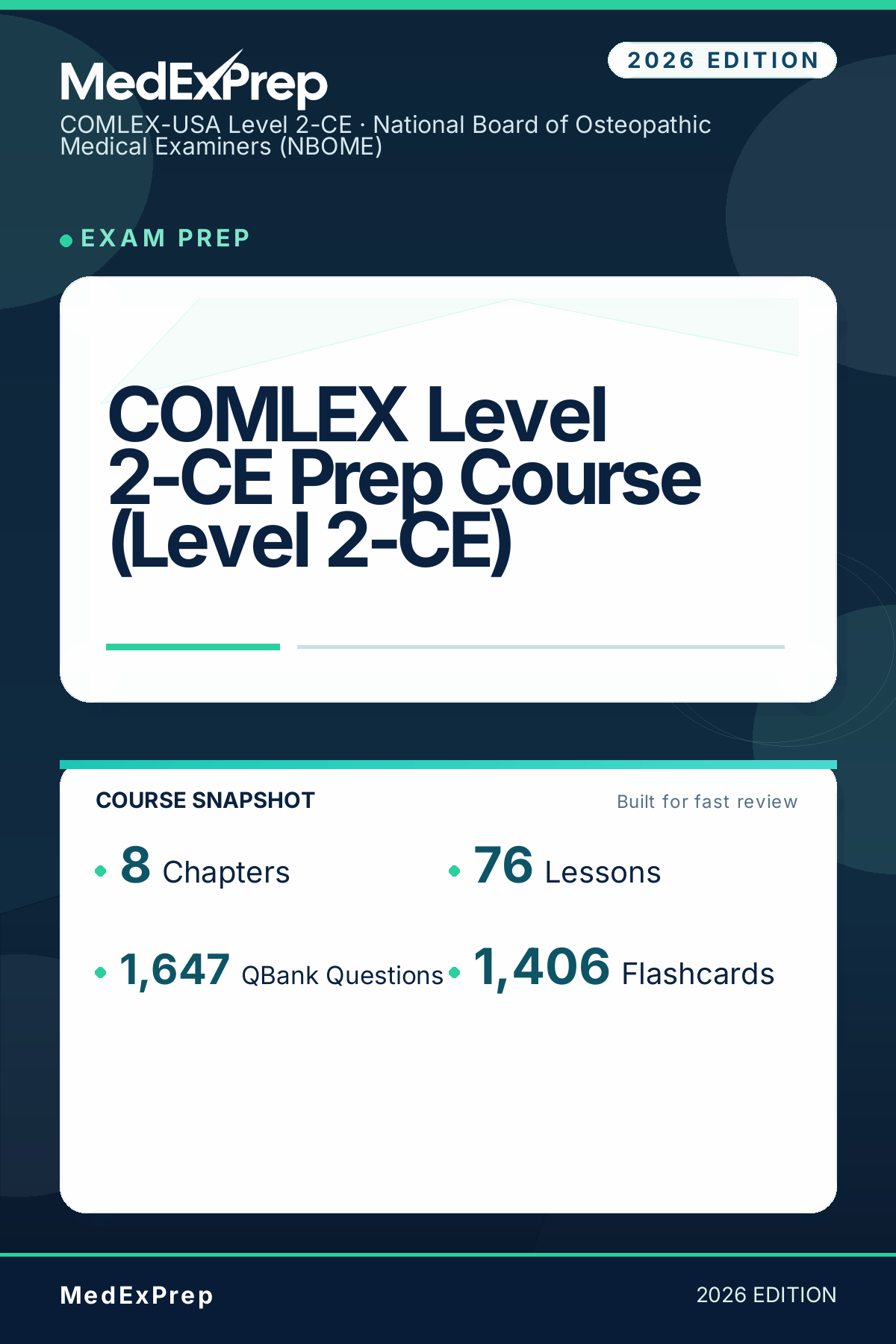
COMLEX Level 2-CE Prep Course (Level 2-CE)
Osteopathic medical students and recent graduates preparing for COMLEX-USA Level 2-CE, especially candidates seeking a clinically integrated, exam-focused review of patient presentation, diagnosis, management, preventive care, ethics, systems-based practice, and osteopathic principles relevant to Level 2-CE. Key goals: By the end of this course, learners will be able to:; Explain the broad exam-relevant competency areas for COMLEX-USA Level 2-CE and use them to organize study without relying on invented official weighting claims..
Exam: COMLEX-USA Level 2-CE · Organization: National Board of Osteopathic Medical Examiners (NBOME)
Includes: Lessons + Flashcards + QBank
Audience: Osteopathic medical students and recent graduates preparing for COMLEX-USA Level 2-CE, especially candidates seeking a clinically integrated, exam-focused review of patient presentation, diagnosis, management, preventive care, ethics, systems-based practice, and osteopathic principles relevant to Level 2-CE.
Goals:
- By the end of this course, learners will be able to:
- Explain the broad exam-relevant competency areas for COMLEX-USA Level 2-CE and use them to organize study without relying on invented official weighting claims.
- Recognize high-yield clinical presentations across ambulatory, inpatient, emergency, perioperative, obstetric, pediatric, psychiatric, preventive, and transitional care settings.
- Apply a consistent board-style reasoning framework: identify the clinical task → extract key findings → prioritize instability/red flags → select the governing diagnostic or management principle → eliminate distractors/contraindications → verify the safest best answer.
- Make diagnosis and management decisions expected of an entry-level supervised physician, including best initial test, confirmatory workup, best next step, first-line treatment, stabilization, disposition, follow-up, and complication recognition.
- Integrate preventive care, screening, counseling, ethics, communication, informed consent, confidentiality, capacity, patient safety, handoffs, and systems-based practice into clinical decision-making.
- Apply osteopathic principles and practice when clinically relevant, including structural reasoning, viscerosomatic considerations, appropriate OMT use, and situations in which OMT is contraindicated or should be deferred.
- Distinguish common distractors, look-alike diagnoses, unsafe interventions, and sequencing errors frequently tested in vignette-based questions.
- Interpret common exam data accurately, including vitals, physical findings, laboratory trends, ECG patterns, imaging descriptions, medication effects, and bedside clinical clues.
- Build retrieval-ready knowledge using concise tables, checklists, algorithms, illness scripts, and spaced review summaries.
- Demonstrate readiness with self-checks and mini-assessments mapped to explicit course tags such as DOMAIN: Clinical Presentation, DOMAIN: Diagnosis/Management, DOMAIN: Osteopathic Principles/OMT, and DOMAIN: Professionalism/Patient Safety, with teachable subskills under each domain.
- Coverage & Blueprint Mapping Requirements:
- Every chapter, section, subsection, and topic must map to at least one explicit domain tag and one subskill tag, even where the official blueprint language is broad.
- Use consistent mapping tags such as DOMAIN: Clinical Presentation, DOMAIN: Diagnosis/Management, DOMAIN: Osteopathic Principles/OMT, and DOMAIN: Professionalism/Patient Safety, then translate each into teachable subskills.
- Ensure balanced coverage across adult medicine, surgery/perioperative care, pediatrics, obstetrics/gynecology, psychiatry, emergency/urgent care, preventive care, ethics/communication, and osteopathic considerations without asserting unverified official percentages.
- Ensure complete coverage: no domain or major clinical task area is left unmapped; if an emphasis detail is uncertain, use learner-safe guidance and broad standard-of-care phrasing rather than guessing.
- Emphasize clinically integrated, presentation-to-management reasoning and include meaningful coverage of stabilization priorities, contraindications, follow-up, prevention, and safety-sensitive decisions.
Access is granted immediately after purchase.