Description
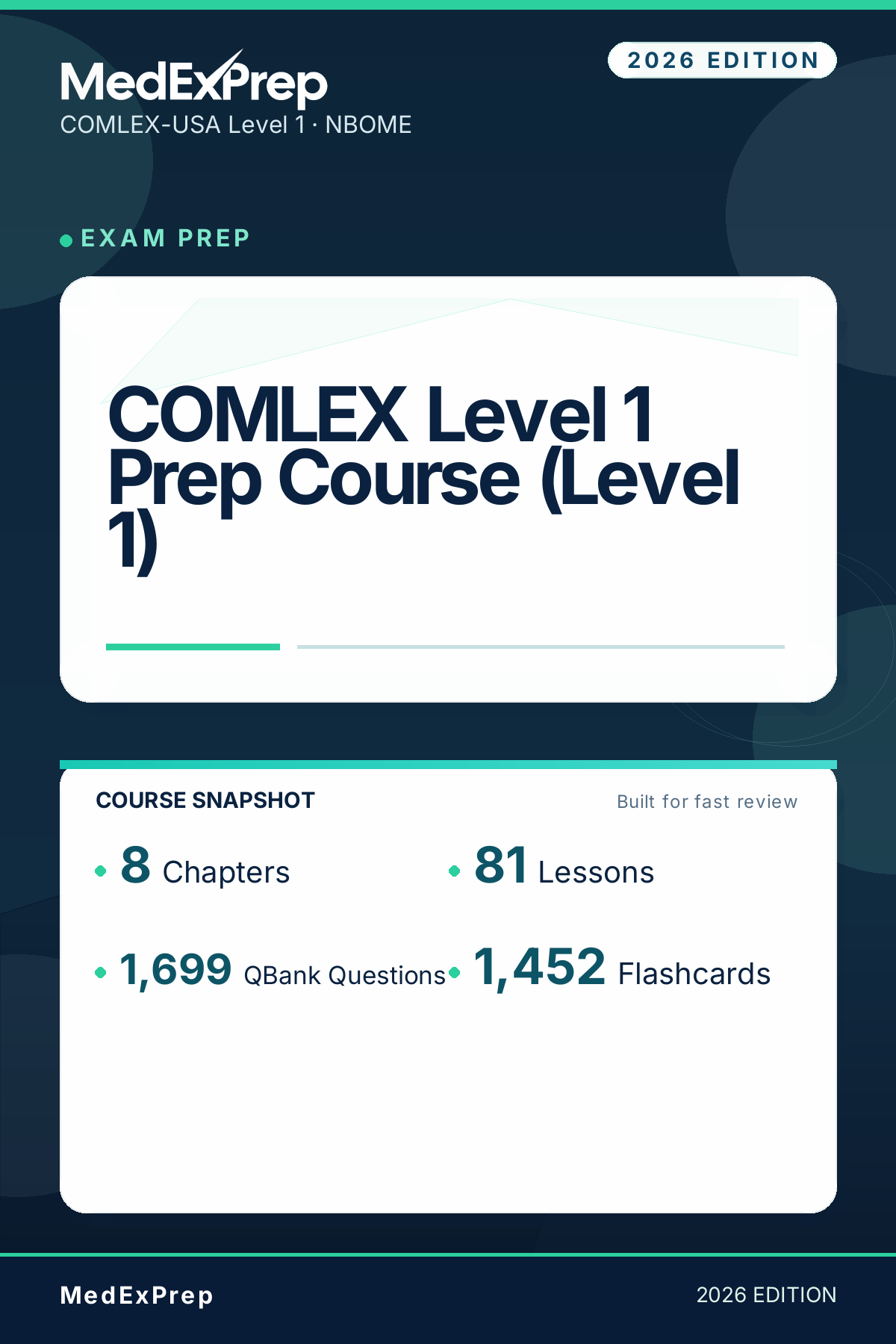
COMLEX Level 1 Prep Course (Level 1)
Osteopathic medical students and other COMLEX-USA Level 1 candidates preparing for first-attempt or repeat-test success on a foundational biomedical science licensure exam with integrated osteopathic principles, OPP/OMM reasoning, and early clinical vignette interpretation. Key goals: By the end of this course, learners will be able to:; Explain the broad exam scope for COMLEX-USA Level 1 and organize study by foundational science, systems integration, quantitative reasoning, patient safety/ethics, and osteopathic principles/OPP-OMM topics without assuming undisclosed official weightings..
Exam: COMLEX-USA Level 1 · Organization: NBOME
Includes: Lessons + Flashcards + QBank
Audience: Osteopathic medical students and other COMLEX-USA Level 1 candidates preparing for first-attempt or repeat-test success on a foundational biomedical science licensure exam with integrated osteopathic principles, OPP/OMM reasoning, and early clinical vignette interpretation.
Goals:
- By the end of this course, learners will be able to:
- Explain the broad exam scope for COMLEX-USA Level 1 and organize study by foundational science, systems integration, quantitative reasoning, patient safety/ethics, and osteopathic principles/OPP-OMM topics without assuming undisclosed official weightings.
- Master high-yield foundational concepts across anatomy, physiology, pathology, pharmacology, microbiology, immunology, biochemistry, genetics, behavioral science, ethics, epidemiology/biostatistics, and osteopathic principles and practice.
- Apply integrated basic-science reasoning to board-style single-best-answer vignettes by identifying the task, extracting key stem facts, localizing the system or process, selecting the governing mechanism/principle, eliminating near-miss distractors, and verifying the best answer.
- Interpret common Level 1 data formats accurately, including labs, physiology relationships, acid-base problems, graphs, tables, and quantitative biostatistics/risk calculations, showing steps when calculation is required.
- Recognize and distinguish commonly tested distractors, mechanism confusions, contraindications, boundary cases, and look-alike diagnoses/drug effects that separate correct from tempting wrong answers.
- Apply osteopathic principles and practice at Level 1 depth, including structure-function concepts, structural diagnosis pattern recognition, viscerosomatic/Chapman/facilitated segment associations, cranial and sacral foundational concepts, and treatment reasoning using learner-safe wording where instructional emphasis may vary.
- Build retrieval-ready memory using concise mechanism maps, organ-system integration tables, OMM pattern summaries, checklists, and spaced-review rapid recaps.
- Demonstrate readiness through self-checks and mini-assessments mapped to explicit content tags for every topic.
- Coverage & Blueprint Mapping Requirements:
- Every chapter, section, subsection, and topic must map to at least one exam-aligned domain or internally defined subskill tag.
- Because publicly available blueprint detail may be broad, translate topics into consistent teachable tags using this format: DOMAIN: Objective -> Subskill.
- Ensure complete coverage across foundational sciences, systems integration, quantitative reasoning, OPP/OMM, and patient safety/ethics; no domain should be left unmapped.
- Use exam-aligned internal tags such as: Foundational Science, Systems Integration, OPP/OMM, Patient Safety/Quality, and Quantitative Reasoning.
- If scope detail is uncertain, provide learner-safe guidance and prioritize high-yield integrated mechanisms; do not invent hidden NBOME blueprint specifics or numerical weightings.
- Keep all content at COMLEX Level 1 scope: foundational biomedical science integration and early clinical reasoning, not residency-level management or highly specialized protocol detail.
Access is granted immediately after purchase.