Description
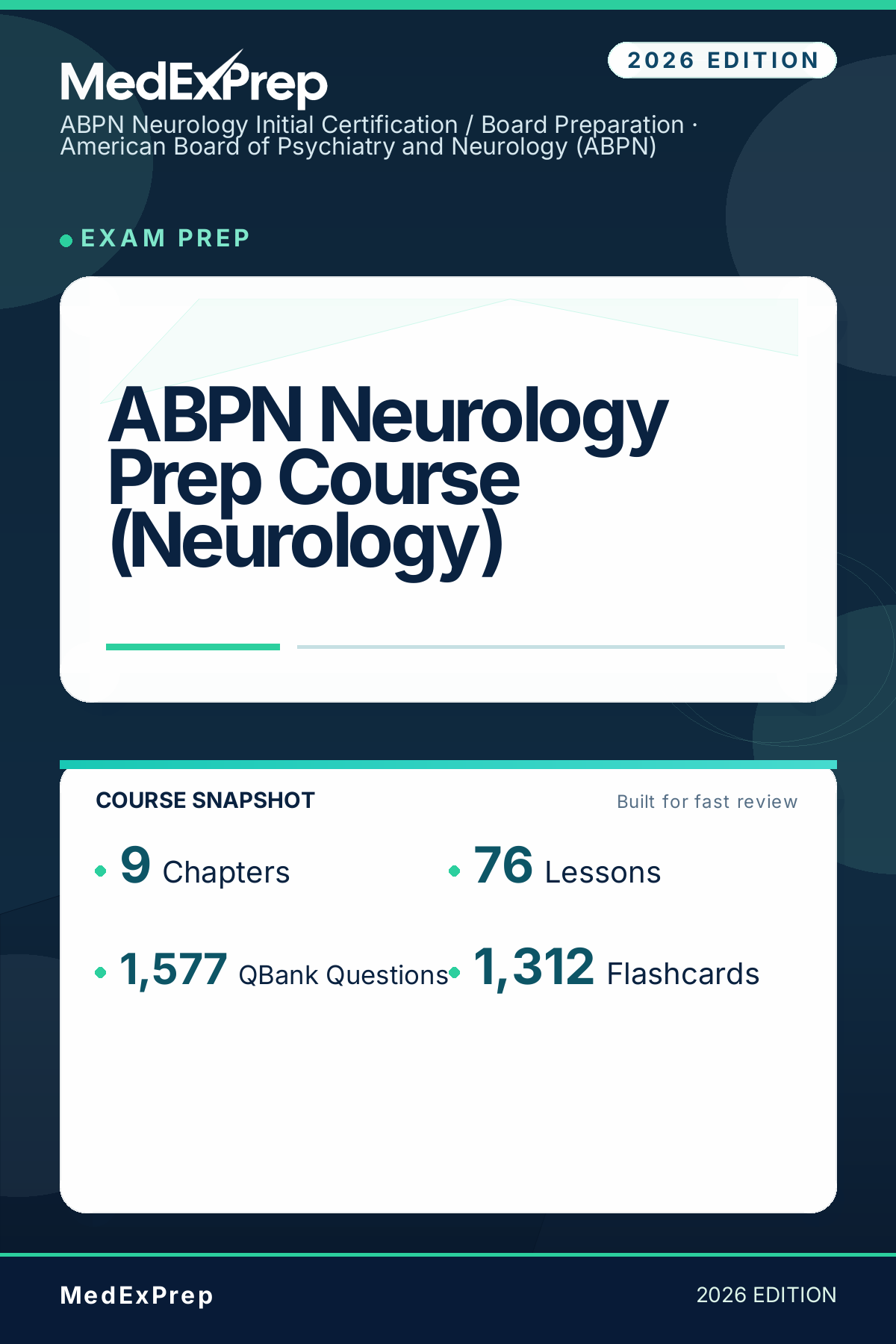
ABPN Neurology Prep Course (Neurology)
Physicians preparing for the ABPN Neurology board exam, including adult neurology residents, recent graduates, and practicing neurologists seeking initial board certification review. Key goals: By the end of this course, learners will be able to:; Explain the board-relevant neurology domain structure used in this course and navigate topic coverage without relying on unverified official weighting claims..
Exam: ABPN Neurology Initial Certification / Board Preparation · Organization: American Board of Psychiatry and Neurology (ABPN)
Includes: Lessons + Flashcards + QBank
Audience: Physicians preparing for the ABPN Neurology board exam, including adult neurology residents, recent graduates, and practicing neurologists seeking initial board certification review.
Goals:
- By the end of this course, learners will be able to:
- Explain the board-relevant neurology domain structure used in this course and navigate topic coverage without relying on unverified official weighting claims.
- Master high-yield clinical neurology concepts across adult board-relevant domains, including localization, diagnosis, diagnostic testing, acute management, chronic management, complication recognition, and distinguishing look-alike disorders.
- Apply a consistent board-style reasoning framework in clinical vignettes: identify the task → localize when relevant → extract key facts → select the governing rule, diagnostic approach, or management principle → execute → verify against competing diagnoses.
- Localize lesions accurately across cortex, subcortex, brainstem, cerebellum, spinal cord, anterior horn cell, root, plexus, peripheral nerve, neuromuscular junction, and muscle using examination patterns and syndrome clues.
- Diagnose and manage common and high-stakes neurologic conditions tested in board preparation, including cerebrovascular disease, epilepsy, headache, movement disorders, neuromuscular disease, demyelinating/neuroimmunologic disorders, cognitive/behavioral neurology, neuroinfectious disease, sleep neurology, neuro-ophthalmology, neuro-oncology, autonomic disorders, and emergency/critical care neurology.
- Select, interpret, and apply common neurologic diagnostic data in board-style scenarios, including CT/MRI patterns, EEG summaries, EMG/NCS findings, CSF profiles, laboratory findings, pathology descriptions, and genetics when relevant.
- Distinguish common distractors, misleading surface features, mimics, and boundary cases that frequently appear in single-best-answer neurology questions.
- Use concise retrieval tools such as localization maps, comparison tables, diagnostic algorithms, treatment checklists, and rapid-review summaries to strengthen retention.
- Demonstrate readiness through self-checks and mini-assessments mapped to board-relevant domains and subskills.
- Coverage & Blueprint Mapping Requirements:
- Every chapter, section, subsection, and topic must map to at least one board-relevant neurology domain or objective.
- Use learner-safe mapping language when official ABPN blueprint wording or weighting is broad, missing, or ambiguous; do not present inferred categories as official ABPN blueprint text.
- Translate broad objectives into teachable subskills using a consistent tag format: DOMAIN: Objective → Subskill.
- Ensure complete coverage across major adult neurology domains, including at minimum: neuroanatomy/localization; cerebrovascular disease; epilepsy; headache/facial pain; movement disorders; neuromuscular disorders; neuroimmunology/multiple sclerosis; neuroinfectious disease; dementia/cognitive neurology; behavioral neurology/neuropsychiatry overlap; sleep neurology; neuro-oncology; neuro-ophthalmology; autonomic disorders; pediatric-to-adult relevant inherited/developmental neurology when board-relevant; critical care/emergency neurology; diagnostic testing/interpretation; ethics/professionalism/patient safety when applicable.
- No major domain should be left unmapped. If a detail is uncertain or practice-dependent, write learner-safe guidance such as “Local protocols vary; confirm with your institution” rather than guessing or inserting internal review notes.
- Favor balanced, high-yield board preparation coverage rather than unsupported claims about official percentages.
Access is granted immediately after purchase.