Description
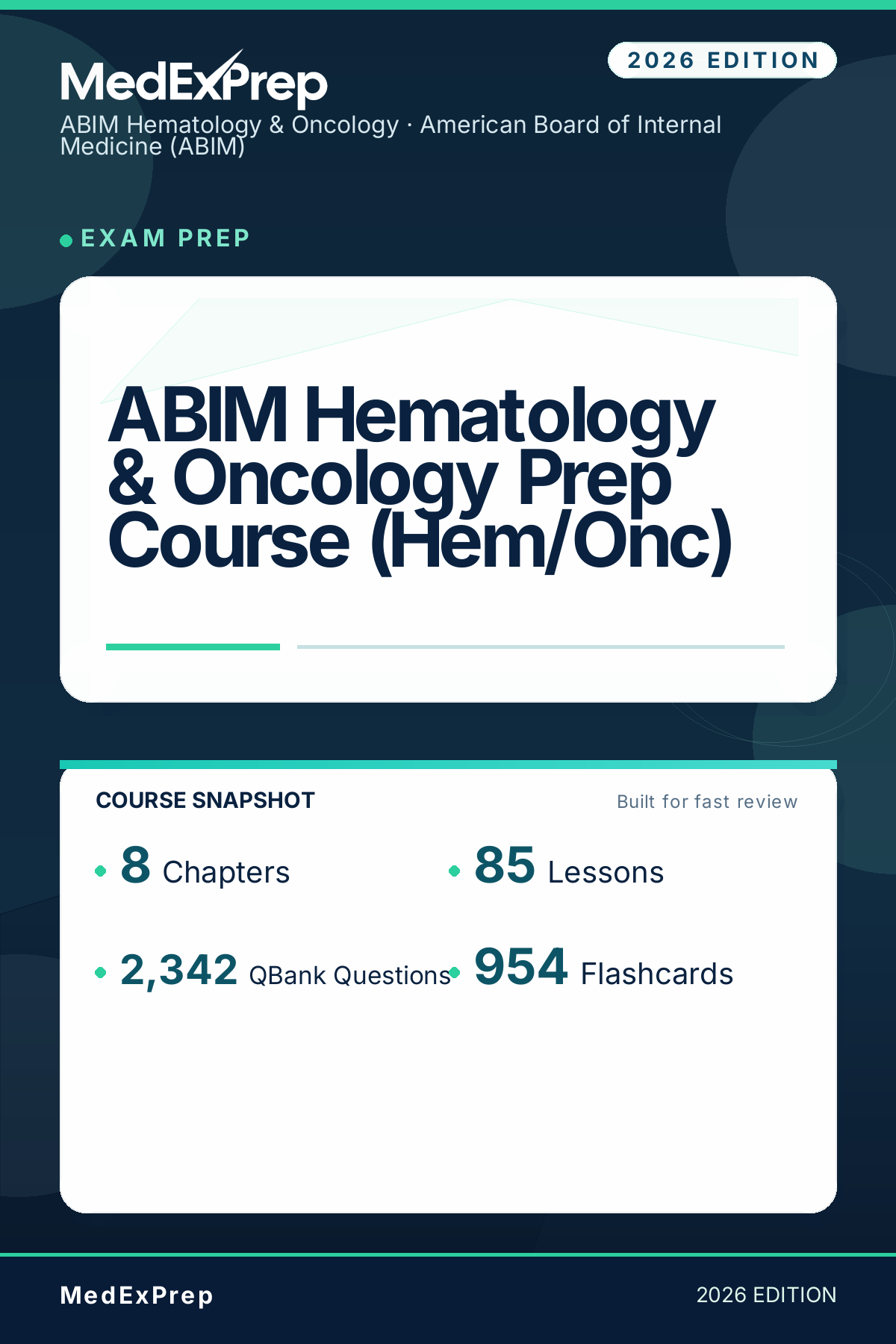
ABIM Hematology & Oncology Prep Course (Hem/Onc)
Physicians preparing for the ABIM Hematology & Oncology certification or recertification examination, including hematology-oncology fellows and practicing hematologist-oncologists seeking a high-yield, board-focused review. Key goals: By the end of this course, learners will be able to:; Explain the ABIM Hematology & Oncology exam scope at a high-yield level and organize study by major domains such as hematologic malignancies, solid tumors, benign hematology, coagulation/thrombosis, transfusion medicine, stem cell transplantation/cellular therapy principles, supportive care/palliative care/survivorship, cancer genetics/prevention, and core diagnostic reasoning..
Exam: ABIM Hematology & Oncology · Organization: American Board of Internal Medicine (ABIM)
Includes: Lessons + Flashcards + QBank
Audience: Physicians preparing for the ABIM Hematology & Oncology certification or recertification examination, including hematology-oncology fellows and practicing hematologist-oncologists seeking a high-yield, board-focused review.
Goals:
- By the end of this course, learners will be able to:
- Explain the ABIM Hematology & Oncology exam scope at a high-yield level and organize study by major domains such as hematologic malignancies, solid tumors, benign hematology, coagulation/thrombosis, transfusion medicine, stem cell transplantation/cellular therapy principles, supportive care/palliative care/survivorship, cancer genetics/prevention, and core diagnostic reasoning.
- Master the high-yield concepts, definitions, classifications, staging systems, prognostic frameworks, and management rules most likely to be tested in hematology and medical oncology board-style scenarios.
- Apply concepts in realistic exam-style physician vignettes, including diagnosis, differential diagnosis, risk stratification, next-best-step management, treatment selection/sequencing, complication management, and longitudinal follow-up decisions.
- Interpret pathology, CBC/coagulation data, peripheral smear findings, marrow/flow/cytogenetic/molecular data, transfusion scenarios, and disease-monitoring trends accurately and explicitly.
- Solve common calculation and logic tasks when applicable, showing steps and reasoning rather than relying on unexplained shortcuts.
- Distinguish common distractors, look-alike diagnoses, toxicities, staging/classification boundary cases, and near-miss management choices that frequently appear on board examinations.
- Use a consistent physician-level problem-solving framework: identify the task → extract key clinical facts → classify the disease/process → select the governing rule or guideline-aligned principle → execute the decision → verify against safety issues, contraindications, and exam wording.
- Build retrieval-ready memory using concise tables, checklists, algorithms, toxicity grids, and spaced-review summaries.
- Demonstrate readiness through self-check questions and mini-assessments mapped across all major course domains with balanced coverage of both hematology and oncology.
- Coverage & Blueprint Mapping Requirements:
- Every chapter, section, subsection, and topic must map to at least one exam content domain or teachable objective relevant to ABIM Hematology & Oncology.
- Use a consistent mapping tag format: DOMAIN: Topic → Subskill.
- At minimum, ensure coverage across these broad domains: Hematologic Malignancies; Solid Tumors; Benign Hematology; Coagulation and Thrombosis; Transfusion Medicine; Stem Cell Transplantation and Cellular Therapy Principles; Supportive Care, Palliative Care, and Survivorship; Cancer Genetics, Prevention, and Special Topics; General Diagnostic Reasoning and Core Test Interpretation.
- When official blueprint language or weighting is unavailable or vague, translate broad areas into explicit teachable subskills and ensure no major domain is left unmapped.
- Do not invent official ABIM weighting percentages or unpublished blueprint details. If emphasis is uncertain, distribute coverage according to publicly available ABIM information and high-yield core practice areas.
- Maintain explicit and substantial balance between hematology and oncology content so that neither side of the credential dominates the course.
- If a management detail varies by institution or rapidly evolving guidance, write learner-safe guidance such as: "Practice patterns and protocols may vary; confirm current local and guideline standards."
Access is granted immediately after purchase.