Description
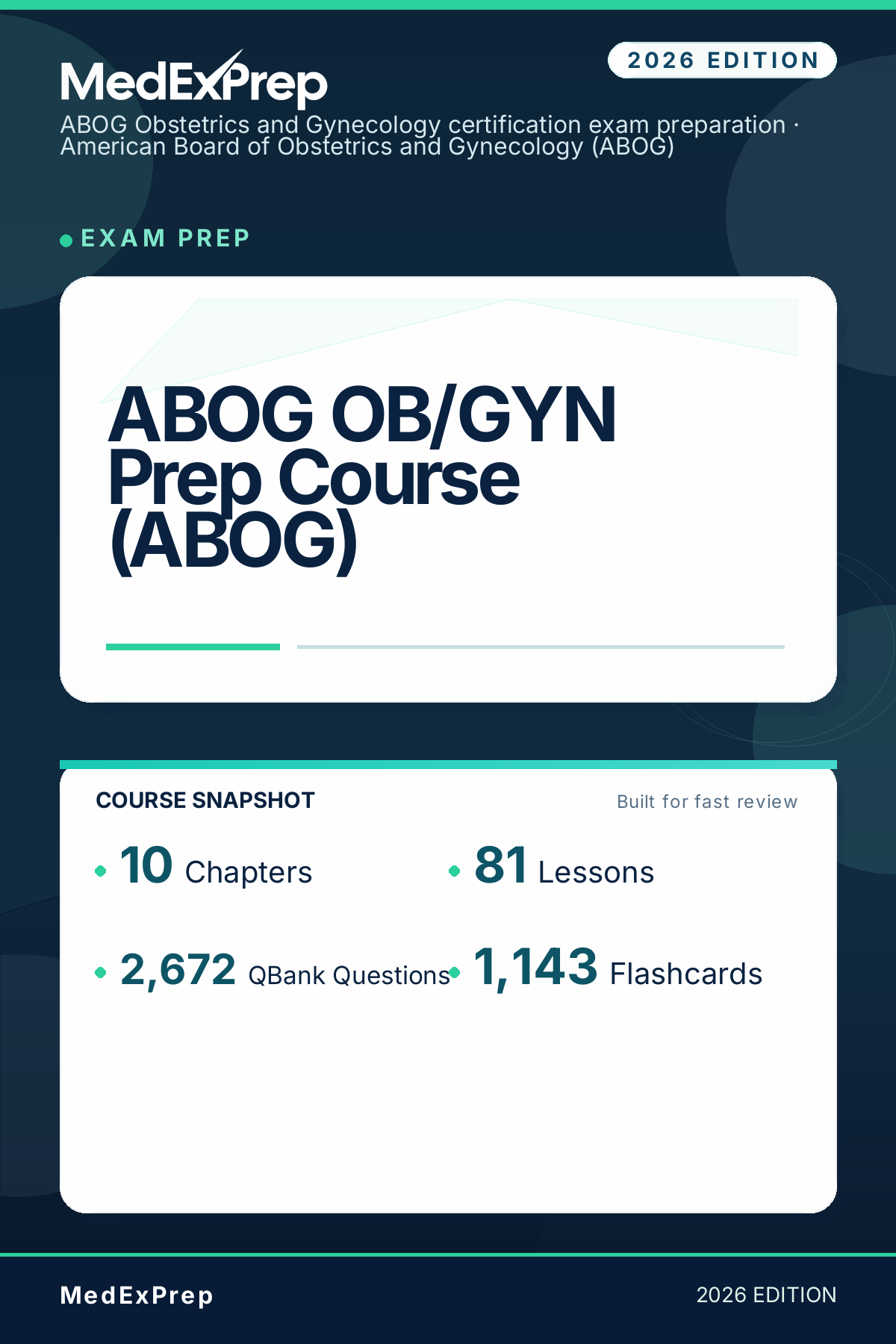
ABOG OB/GYN Prep Course (ABOG)
Physicians preparing for the ABOG Obstetrics and Gynecology examination, including OB/GYN residents nearing graduation, board-eligible obstetrician-gynecologists pursuing initial certification, and practicing physicians seeking focused board-style review. Key goals: By the end of this course, learners will be able to:; Explain the broad ABOG OB/GYN exam domain structure and organize study across major physician-level content areas without relying on unpublished blueprint details..
Exam: ABOG Obstetrics and Gynecology certification exam preparation · Organization: American Board of Obstetrics and Gynecology (ABOG)
Includes: Lessons + Flashcards + QBank
Audience: Physicians preparing for the ABOG Obstetrics and Gynecology examination, including OB/GYN residents nearing graduation, board-eligible obstetrician-gynecologists pursuing initial certification, and practicing physicians seeking focused board-style review.
Goals:
- By the end of this course, learners will be able to:
- Explain the broad ABOG OB/GYN exam domain structure and organize study across major physician-level content areas without relying on unpublished blueprint details.
- Master high-yield definitions, diagnostic criteria, management principles, contraindications, and safety priorities across core obstetrics, maternal-fetal assessment, labor and delivery, postpartum care, gynecology, reproductive endocrinology/infertility, gynecologic oncology, urogynecology, preventive care, ethics/professionalism, and perioperative/surgical decision-making.
- Apply concepts in realistic board-style clinical scenarios involving diagnosis, best next step, initial stabilization, definitive management, interpretation of monitoring/tests, and prevention/follow-up planning.
- Use a consistent physician reasoning framework: identify the task → determine acuity and safety priorities → extract key maternal/fetal/surgical facts → select the governing rule or guideline-informed principle → execute the best next step → verify against contraindications and distractors.
- Distinguish common distractors and boundary cases, especially initial stabilization vs definitive treatment, emergent vs urgent vs routine management, structural vs nonstructural causes, benign vs malignant risk patterns, and maternal vs fetal priority conflicts.
- Interpret common board-relevant clinical data accurately, including laboratory values, fetal heart tracing descriptions, ultrasound/imaging findings, screening results, pathology/cytology descriptors, and risk-based management pathways.
- Build retrieval-ready memory using concise tables, checklists, algorithms, staging/classification summaries, and spaced-review recaps.
- Demonstrate readiness through self-checks and mini-assessments mapped across all major OB/GYN domains.
- Coverage & Blueprint Mapping Requirements:
- Every chapter/section/subsection/topic must map to at least one domain/objective, using a consistent label format such as DOMAIN: Objective → Subskill.
- Because official/public blueprint wording may be broad, translate each major OB/GYN area into teachable physician-level subskills while avoiding claims of unpublished exact exam weightings.
- Ensure complete coverage across the following course map: Obstetrics; Maternal-Fetal Assessment; Labor and Delivery; Postpartum Care; Gynecology; Reproductive Endocrinology and Infertility; Gynecologic Oncology; Urogynecology and Pelvic Floor Disorders; Preventive Care and Office Practice; Ethics and Professionalism; Perioperative and Surgical Decision-Making.
- No domain/objective may be left unmapped. Include diagnosis, criteria, management principles, preventive care, perioperative judgment, emergency stabilization, and interpretation tasks where applicable.
- If a recommendation depends on local policy or institutional workflow, use learner-safe wording such as “Local protocols vary; confirm with your institution.” Do not guess unpublished standards or institution-specific pathways.
Access is granted immediately after purchase.