Description
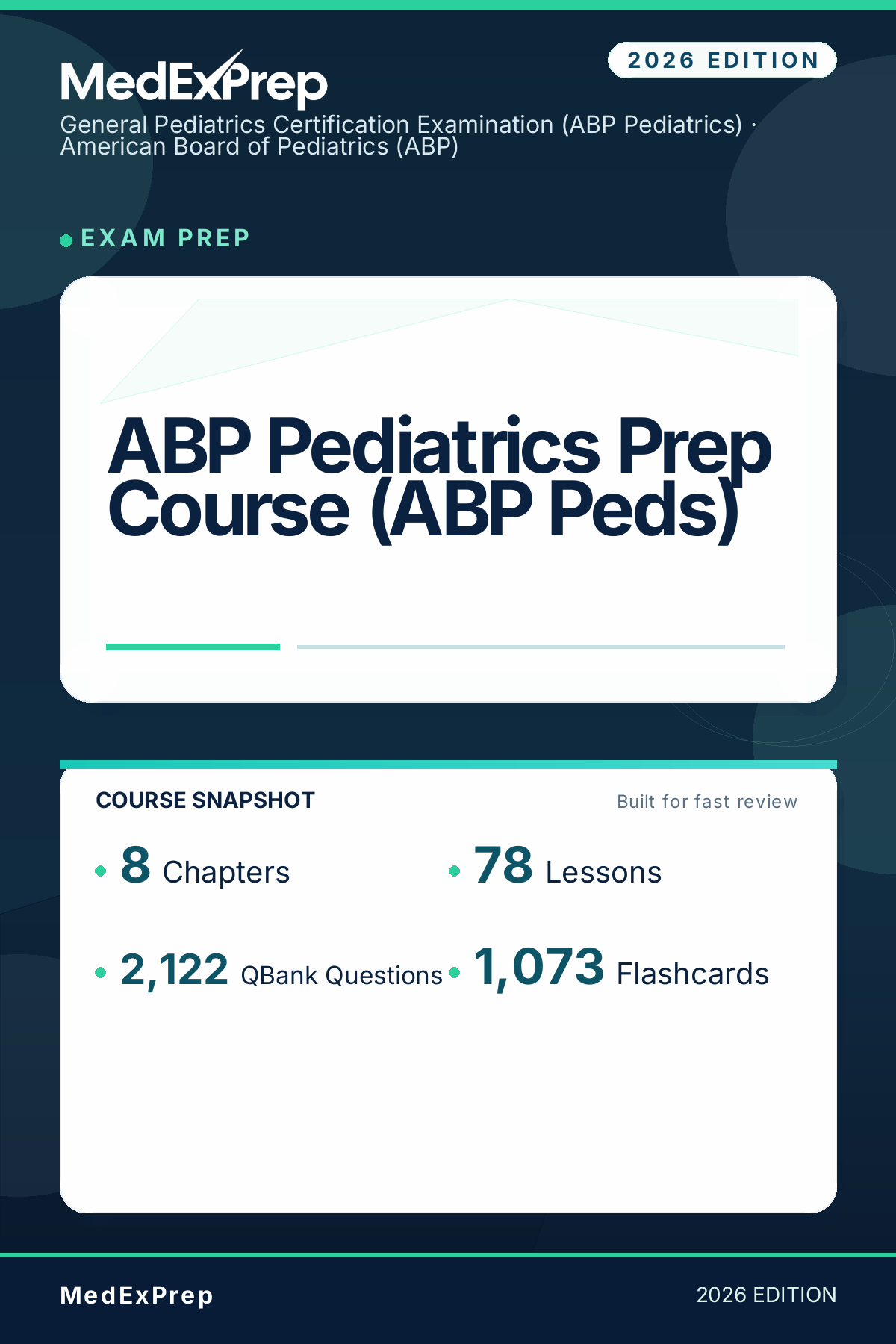
ABP Pediatrics Prep Course (ABP Peds)
Pediatric residents, recent pediatric residency graduates, and practicing physicians preparing for the ABP General Pediatrics board certification or recertification-style exam. Target the general pediatrician role across outpatient primary care, urgent care, emergency recognition/initial stabilization, newborn nursery, inpatient pediatrics, adolescent care, and preventive health supervision visits. Key goals: By the end of this course, learners will be able to:; Explain the broad exam-relevant content domains for ABP General Pediatrics and use explicit topic-to-domain mappings rather than assumed hidden blueprint weightings..
Exam: General Pediatrics Certification Examination (ABP Pediatrics) · Organization: American Board of Pediatrics (ABP)
Includes: Lessons + Flashcards + QBank
Audience: Pediatric residents, recent pediatric residency graduates, and practicing physicians preparing for the ABP General Pediatrics board certification or recertification-style exam. Target the general pediatrician role across outpatient primary care, urgent care, emergency recognition/initial stabilization, newborn nursery, inpatient pediatrics, adolescent care, and preventive health supervision visits.
Goals:
- By the end of this course, learners will be able to:
- Explain the broad exam-relevant content domains for ABP General Pediatrics and use explicit topic-to-domain mappings rather than assumed hidden blueprint weightings.
- Master the high-yield concepts, age-specific norms, definitions, diagnostic criteria, and first-line management rules across general pediatrics domains, including newborn care, growth/development, prevention/immunizations, nutrition, adolescent medicine, behavioral health, child abuse/advocacy, genetics/metabolic disease, emergency recognition, and core organ-system pediatrics.
- Apply pediatric clinical reasoning in realistic board-style scenarios: identify the task, determine age and care setting, extract key findings and timeline, prioritize dangerous diagnoses, select the most appropriate next diagnostic or management step, and verify against pediatric guidance and age-specific norms.
- Interpret common pediatric data accurately, including growth parameters, developmental milestones, vital signs by age, immunization schedules, screening results, common laboratory patterns, and basic imaging when applicable.
- Distinguish common distractors, look-alike diagnoses, misconceptions, and boundary cases frequently tested in general pediatrics, especially normal variants versus pathology and outpatient management versus urgent escalation.
- Recognize red flags and time-sensitive pediatric conditions requiring immediate stabilization, emergency treatment, hospital-level care, consultation, or referral.
- Use concise tables, checklists, algorithms, comparison charts, and spaced-review summaries to build retrieval-ready memory for high-yield pediatric patterns.
- Demonstrate readiness through self-checks and mini-assessments mapped to explicit domain/subskill tags in the format DOMAIN: Topic → Subskill.
- Coverage & Blueprint Mapping Requirements:
- Every chapter, section, subsection, and topic must map to at least one ABP-relevant content domain/subskill tag, even when public blueprint language is broad.
- Use a consistent mapping format: DOMAIN: Topic → Subskill.
- Ensure complete coverage across major general pediatrics domains, including: NEWBORN CARE; GROWTH, DEVELOPMENT, AND BEHAVIOR; PREVENTIVE PEDIATRICS AND IMMUNIZATIONS; NUTRITION; ADOLESCENT MEDICINE; BEHAVIORAL/MENTAL HEALTH; CHILD ABUSE, ADVOCACY, AND ETHICS; GENETICS AND METABOLIC DISEASE; EMERGENCY AND CRITICAL RECOGNITION; CARDIOLOGY; PULMONOLOGY; GASTROENTEROLOGY; NEPHROLOGY/UROLOGY; ENDOCRINOLOGY; HEMATOLOGY/ONCOLOGY; INFECTIOUS DISEASES; NEUROLOGY; RHEUMATOLOGY; ALLERGY/IMMUNOLOGY; DERMATOLOGY; and MUSCULOSKELETAL MEDICINE/ORTHOPEDICS.
- Also map cross-cutting skills where relevant: age-based normal values and milestones, best next step in diagnosis, best next step in management, urgency recognition and escalation, preventive counseling and screening, immunization planning, interpretation of growth/development data, distinguishing distractors/look-alikes, disposition, and referral indications.
- Do not invent official ABP blueprint weightings or unpublished specifications.
- If a public blueprint detail is uncertain or broad, translate it into teachable subskills and flag any coverage gap through explicit mapping rather than omission; use learner-safe guidance such as “follow current national guidance and local protocols when applicable.”
Access is granted immediately after purchase.