Description
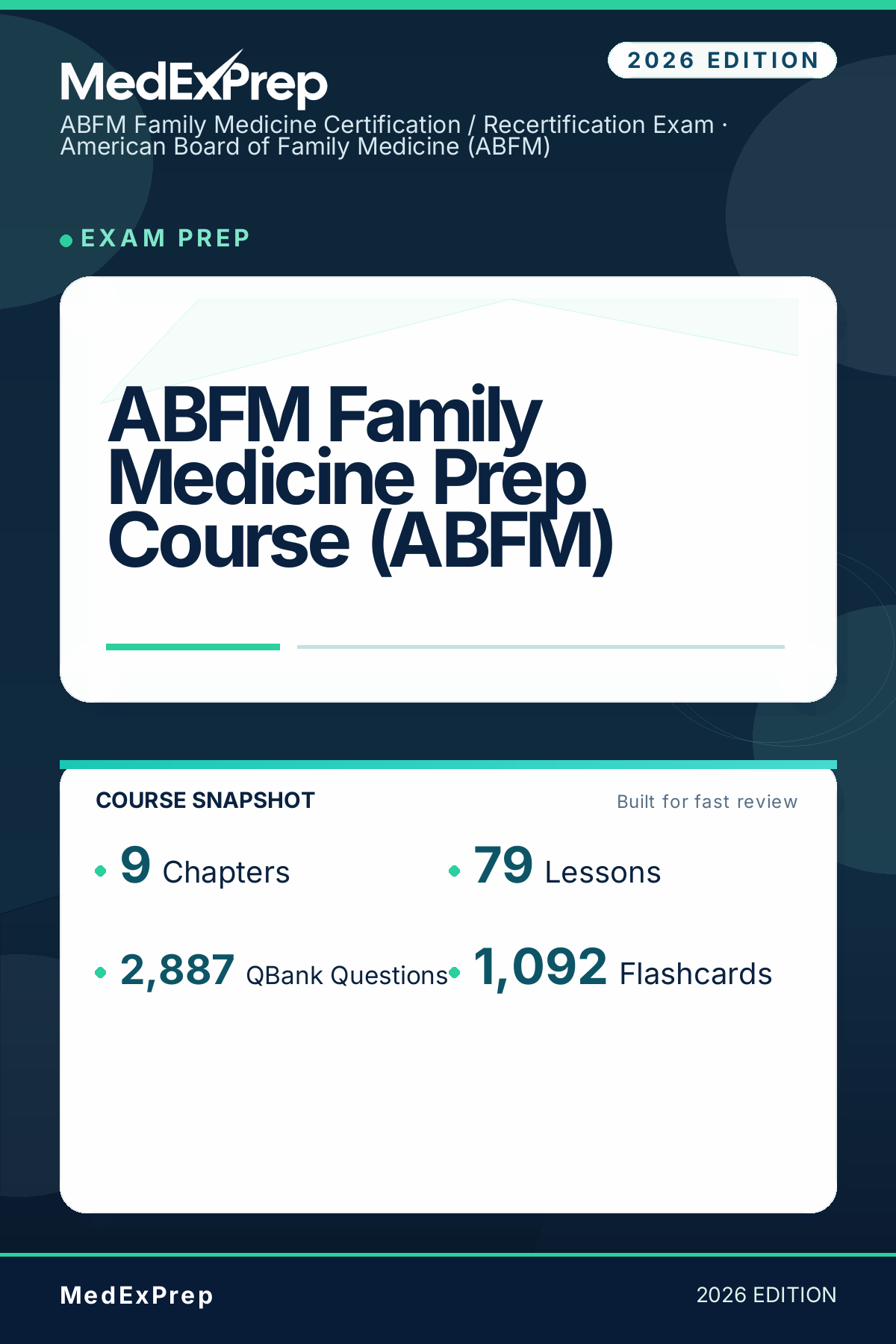
ABFM Family Medicine Prep Course (ABFM)
Family physicians and family medicine candidates preparing for the ABFM Family Medicine examination, including family medicine residents, recent graduates, and practicing physicians seeking initial certification or continuing certification/recertification. Key goals: By the end of this course, learners will be able to:; Explain the broad family medicine exam domains used in this course and how each lesson maps to explicit domain/subskill tags, without assuming unpublished ABFM blueprint weights..
Exam: ABFM Family Medicine Certification / Recertification Exam · Organization: American Board of Family Medicine (ABFM)
Includes: Lessons + Flashcards + QBank
Audience: Family physicians and family medicine candidates preparing for the ABFM Family Medicine examination, including family medicine residents, recent graduates, and practicing physicians seeking initial certification or continuing certification/recertification.
Goals:
- By the end of this course, learners will be able to:
- Explain the broad family medicine exam domains used in this course and how each lesson maps to explicit domain/subskill tags, without assuming unpublished ABFM blueprint weights.
- Master high-yield, board-relevant concepts across the lifespan in family medicine, including prevention, screening, acute care, chronic disease management, women’s health, pediatrics, geriatrics, behavioral health, population health, procedures/clinical skills, and ethics/communication.
- Apply family medicine reasoning in realistic single-best-answer clinical scenarios: identify the task → extract key clinical facts → prioritize likely diagnoses or risks → choose the best next step/management option → verify against red flags, contraindications, care setting, and patient context.
- Interpret common primary care findings and perform straightforward clinical calculations when applicable, showing steps for staging, risk logic, and management thresholds rather than relying on hidden shortcuts.
- Distinguish near-neighbor diagnoses, tempting outdated practices, correct interventions given at the wrong time or in the wrong setting, and choices that fail to account for age, pregnancy status, comorbidity, severity, or safety.
- Use concise tables, checklists, age-based frameworks, prevention schedules, red-flag summaries, and longitudinal care algorithms to build retrieval-ready memory for board-style decision-making.
- Demonstrate readiness with self-check questions and mini-assessments mapped to explicit domain tags such as DOMAIN: Adult Medicine → Diagnostic reasoning and management, DOMAIN: Preventive Care → Screening/immunizations/counseling, DOMAIN: Pediatrics → Age-specific evaluation and treatment, DOMAIN: Women’s Health → Gynecologic/obstetric/contraceptive/preventive care, DOMAIN: Geriatrics → Function/cognition/medication safety, DOMAIN: Behavioral Health → Mental health and substance use care, DOMAIN: Care of Chronic Disease → Longitudinal management, DOMAIN: Acute/Urgent Care → Initial evaluation/stabilization/disposition, DOMAIN: Population Health → Evidence-based prevention and social context, DOMAIN: Procedures/Clinical Skills → Office-based interpretation and procedural decisions, and DOMAIN: Ethics/Communication → Shared decision-making, confidentiality, professionalism, and safety.
- Coverage & Blueprint Mapping Requirements:
- Every chapter, section, subsection, and topic must map to at least one explicit family medicine domain/subskill tag.
- Because official ABFM blueprint details may be broad or unpublished, translate broad exam-relevant areas into teachable subskills using consistent labels in the format DOMAIN: Topic → Subskill.
- Ensure complete coverage across broad family medicine board scope: adult medicine, pediatrics, women’s health, geriatrics, behavioral health, preventive care, chronic disease care, acute/urgent care, population health, procedures/clinical skills, and ethics/communication.
- Do not invent proprietary ABFM weights, unpublished structures, or unsupported exam details.
- For guideline-sensitive areas such as screening, immunization, prevention, and treatment thresholds, teach durable decision rules and remind learners to confirm current guideline updates when recommendations evolve.
- If a detail is uncertain or varies by institution/jurisdiction, provide learner-safe guidance such as “Local protocols vary; confirm with your institution,” rather than guessing.
Access is granted immediately after purchase.