Description
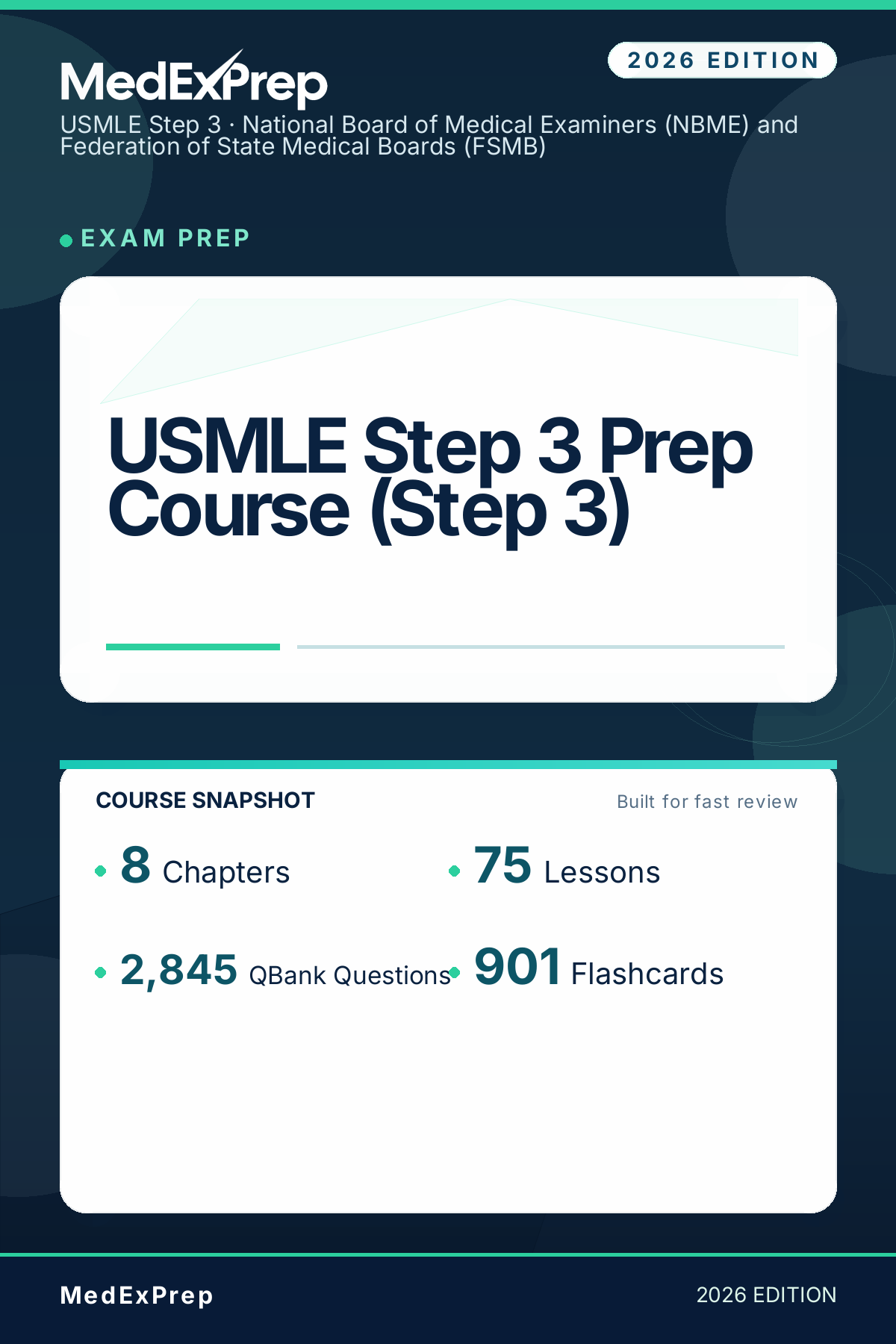
USMLE Step 3 Prep Course (Step 3)
USMLE Step 3 candidates, including U.S. and international medical graduates preparing for the final USMLE examination step focused on physician-level, unsupervised clinical decision-making in ambulatory, inpatient, emergency, perioperative, obstetric, pediatric, psychiatric, and preventive care settings. Key goals: By the end of this course, learners will be able to:; Explain the broad public USMLE Step 3 structure (Foundations of Independent Practice and Advanced Clinical Medicine) and use it to organize study, without relying on unofficial weightings..
Exam: USMLE Step 3 · Organization: National Board of Medical Examiners (NBME) and Federation of State Medical Boards (FSMB)
Includes: Lessons + Flashcards + QBank
Audience: USMLE Step 3 candidates, including U.S. and international medical graduates preparing for the final USMLE examination step focused on physician-level, unsupervised clinical decision-making in ambulatory, inpatient, emergency, perioperative, obstetric, pediatric, psychiatric, and preventive care settings.
Goals:
- By the end of this course, learners will be able to:
- Explain the broad public USMLE Step 3 structure (Foundations of Independent Practice and Advanced Clinical Medicine) and use it to organize study, without relying on unofficial weightings.
- Master high-yield Step 3 concepts, definitions, clinical rules, and management principles across internal medicine, surgery, pediatrics, obstetrics/gynecology, psychiatry, preventive medicine, ethics, patient safety, epidemiology, and biostatistics.
- Apply physician-level clinical reasoning in realistic board-style scenarios by choosing the safest and most appropriate diagnosis, best next step, initial management, confirmatory testing, disposition, counseling, or follow-up plan.
- Prioritize acuity and stability first, distinguishing immediate stabilization from diagnostic refinement, definitive therapy, longitudinal management, and preventive care.
- Solve common quantitative and interpretive tasks accurately when applicable, including diagnostic test characteristics, risk measures, study design, acid-base/electrolyte reasoning, medication/fluid calculations, and evidence interpretation; show steps explicitly and avoid hidden shortcuts.
- Use a consistent Step 3 problem-solving framework: identify the task → assess acuity/stability → extract key facts → select the governing rule or best next step → execute → verify safety, contraindications, and disposition.
- Develop CCS-style reasoning skills, including initial orders, monitoring, reassessment timing, escalation/de-escalation, consultation, preventive counseling, discharge planning, and avoidance of unsafe or unnecessary actions.
- Distinguish common distractors, near-miss diagnoses, premature tests, contraindicated treatments, and boundary cases that are frequently tested in Step 3-style questions.
- Build retrieval-ready memory using concise tables, illness scripts, comparison charts, checklists, algorithms, and spaced review summaries.
- Demonstrate readiness through self-check questions and mini-assessments mapped to explicit Step 3 tags.
- Coverage & Blueprint Mapping Requirements:
- Every chapter/section/subsection/topic must map to at least one explicit Step 3 tag in the form: "STEP3: → → ".
- Use broad public Step 3 categories without inventing numerical weightings or proprietary scoring details; organize content around Foundations of Independent Practice (FIP) and Advanced Clinical Medicine (ACM) when helpful.
- When public blueprint language is broad, translate it into teachable clinical subskills using dimensions such as clinical task, organ system, setting, patient population, acuity, and CCS relevance.
- Ensure complete coverage across diagnosis, initial stabilization, best next step, management, monitoring/follow-up, disposition, prevention/screening, counseling/communication, ethics/legal reasoning, biostatistical interpretation, prognosis/risk assessment, and patient safety.
- Ensure broad specialty coverage across internal medicine, surgery/perioperative care, pediatrics, obstetrics/gynecology, psychiatry, preventive medicine, ethics, patient safety, and biostatistics/epidemiology.
- Include ambulatory, emergency, inpatient, ICU-recognition, perioperative, labor and delivery, postpartum, newborn, pediatric outpatient, and longitudinal follow-up contexts across the course.
- Include dedicated CCS mapping in addition to standard multiple-choice mapping whenever relevant.
- If official blueprint detail is broad or unspecified, use learner-safe wording such as: "Public blueprint detail is broad here; focus on common board-tested presentations, next-step management, and patient safety priorities." Do not guess or invent unsupported exam details.
Access is granted immediately after purchase.