Description
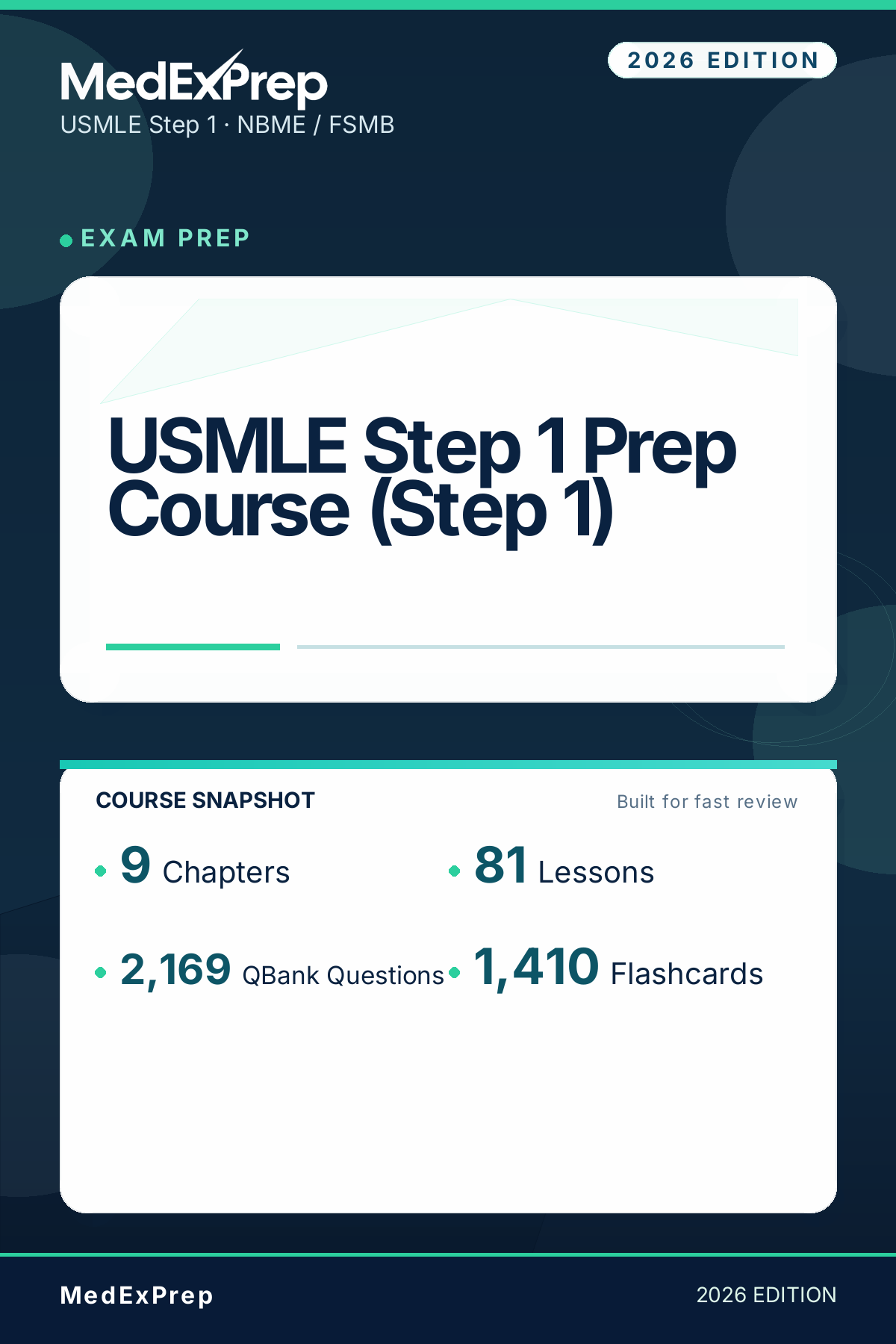
USMLE Step 1 Prep Course (Step 1)
Medical students and other USMLE Step 1 candidates preparing for the pass/fail foundational science exam with emphasis on mechanism-based reasoning, disease processes, and application of basic science to clinical vignettes. Key goals: By the end of this course, learners will be able to:; Explain the broad USMLE Step 1 content structure in learner-safe terms and organize study across general principles, organ systems, and cross-disciplinary foundational sciences without claiming unsupported official weighting details..
Exam: USMLE Step 1 · Organization: NBME / FSMB
Includes: Lessons + Flashcards + QBank
Audience: Medical students and other USMLE Step 1 candidates preparing for the pass/fail foundational science exam with emphasis on mechanism-based reasoning, disease processes, and application of basic science to clinical vignettes.
Goals:
- By the end of this course, learners will be able to:
- Explain the broad USMLE Step 1 content structure in learner-safe terms and organize study across general principles, organ systems, and cross-disciplinary foundational sciences without claiming unsupported official weighting details.
- Master high-yield foundational science concepts across anatomy, physiology, pathology, pharmacology, microbiology, immunology, biochemistry, genetics, embryology, nutrition, behavioral science, ethics, and biostatistics.
- Apply mechanism-based reasoning to realistic USMLE Step 1-style clinical vignettes by linking symptoms, physical findings, pathology, histology, imaging, and laboratory data to underlying basic science principles.
- Distinguish look-alike diseases, mechanisms, organisms, drugs, adverse effects, and genetic patterns using discriminating clues that commonly separate tempting answer choices.
- Solve common quantitative and logic-based tasks accurately when applicable, including biostatistics, epidemiology, genetics probability, acid-base interpretation, and physiology calculations, showing steps rather than relying on hidden shortcuts.
- Use a consistent problem-solving framework: identify the task → extract key facts → localize the system/process → select the governing mechanism or rule → eliminate distractors → verify against the vignette.
- Build retrieval-ready memory using concise tables, comparison grids, mechanism maps, and spaced review summaries focused on high-yield exam distinctions.
- Demonstrate readiness through self-check questions and mini-assessments mapped to course domains and explicit subskills.
- Coverage & Blueprint Mapping Requirements:
- Every chapter/section/subsection/topic must map to at least one clearly labeled course domain/subskill, even when official blueprint language is broad.
- Use a consistent mapping scheme such as: DOMAIN: Topic Area → Subskill.
- Ensure complete coverage across foundational principles and all major organ systems, including cross-disciplinary integration; no major content area should be left unmapped.
- Because publicly available blueprint language is broad, translate each area into teachable, conservative subskills rather than inventing unsupported exam percentages or hidden blueprint details.
- If Step 1 relevance or emphasis of a detail is uncertain, label it as lower priority or optional and keep guidance learner-safe rather than guessing.
- Keep all content within Step 1 scope: foundational science reasoning, early clinical interpretation, and supervised-trainee level application; avoid unsupervised physician-level management, specialty guideline minutiae, billing/administrative content, and procedure-heavy decision making.
Access is granted immediately after purchase.